The yeast question trips up a lot of home pizza makers. You have a recipe calling for 0.3% instant dry yeast, but your pantry only has active dry. Or you found fresh yeast at the Italian specialty shop and want to know if it's worth using. Here's everything you need to know about each type and when to use them.
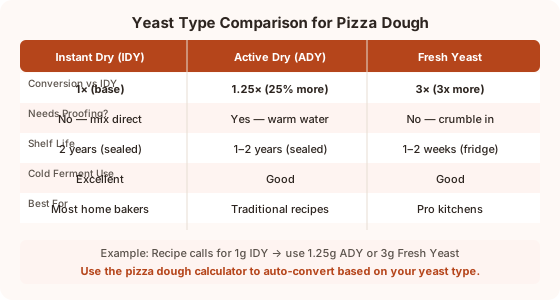
The Three Yeast Types
Instant Dry Yeast (IDY) - also called rapid-rise or fast-acting yeast - has the smallest granules of the three types and the highest concentration of live cells per gram. You can mix it directly into flour without dissolving it first. Brands include SAF Instant (red label for lean doughs), Fleischmann's Rapid Rise, and Caputo Lievito. SAF Instant is the choice of most professional pizzerias when fresh yeast isn't practical.
Active Dry Yeast (ADY) has larger, coarser granules with a dormant outer coating. The conventional instruction is to "proof" it: dissolve in warm water (100–110°F) with a pinch of sugar, wait 5–10 minutes until foamy, then add to the flour. This activates the outer dormant layer. ADY has slightly lower live-cell density than IDY, which is why you need 25% more by weight to match IDY's activity.
Fresh Yeast - also called cake yeast or compressed yeast - is the original baker's yeast. It's highly perishable (1–2 weeks refrigerated), but many traditional European pizza makers swear by its flavor contribution. It's about 70% water by weight, which explains why you need 3× as much to match IDY's fermentation power. You'll find it in the refrigerated section of specialty food stores or Italian markets.
Conversion Ratios
This is the critical information our pizza dough calculator uses to auto-convert between yeast types:
| If recipe calls for | Use this much ADY | Use this much Fresh |
|---|---|---|
| 0.5g IDY | 0.63g ADY | 1.5g Fresh |
| 1g IDY | 1.25g ADY | 3g Fresh |
| 2g IDY | 2.5g ADY | 6g Fresh |
| 5g IDY | 6.25g ADY | 15g Fresh |
These ratios come from guidelines published by King Arthur Baking Company and are consistent with the Bread Baker's Guild of America's technical resources. When you select your yeast type in the calculator, it applies these multipliers automatically; you just enter the percentage you'd use with IDY and the rest is handled.
How Each Yeast Type Affects Flavor
Here's what surprises most people: the yeast type itself doesn't dramatically change flavor. What changes flavor is fermentation time and temperature. A 72-hour cold ferment with IDY will taste better than a 4-hour room-temperature ferment with fresh yeast. The slow, cold fermentation develops organic acids and flavor compounds regardless of which yeast you use.
That said, fresh yeast does have more byproducts than dried forms; some bakers describe a slightly more complex, "yeasty" flavor note. Whether this is meaningful in a finished pizza crust that's been baked at 900°F is debatable.
The more practical advantage of fresh yeast is reliability. It activates faster than IDY at cold temperatures, which matters if you're cold-proofing at very low temperatures (36–38°F). Some professional Neapolitan pizzerias use fresh yeast for this reason.
Proofing IDY vs ADY
IDY doesn't need proofing. Add it directly to flour and mix. The small granules hydrate immediately when they contact water in the dough. If you want to test whether your IDY is still active, you can dissolve a small amount in warm water and watch for bubbles, but this isn't necessary with fresh, properly stored IDY.
ADY benefits from proofing. Dissolve in 100–110°F water with a pinch of sugar. If it doesn't foam within 10 minutes, the yeast is dead and your dough won't rise. Water that's too hot (above 115°F) will kill the yeast before it activates. This temperature sensitivity is why many bakers have switched to IDY.
Fresh yeast can be crumbled directly into flour or dissolved in room-temperature water. Unlike ADY, it doesn't need hot water to activate.
Yeast Percentages for Different Fermentation Timelines
The amount of yeast you use should match your fermentation timeline. This applies to all three yeast types after conversion.
Same-day (4–6 hours at 70°F): 0.3–0.5% IDY equivalent
Overnight (12–16 hours at room temp): 0.15–0.25% IDY equivalent
24-hour cold (38°F): 0.2–0.3% IDY equivalent
48–72 hour cold (38°F): 0.1–0.15% IDY equivalent
For the 48–72 hour cold ferment, 0.1% IDY in a 560g batch works out to just 0.33g; less than a quarter teaspoon. You need a scale accurate to 0.1g to measure this reliably, which is another reason a digital kitchen scale is non-negotiable for serious pizza making.
To calculate exact yeast weights for any percentage and batch size, use the pizza dough ingredient calculator; just select your yeast type and it handles the conversion automatically.
Storage and Shelf Life
IDY: Sealed packet: 2 years at room temperature. Once opened: transfer to an airtight container, refrigerate, and use within 4 months. IDY that's past its date often still works at reduced potency.
ADY: Similar to IDY; 1–2 years sealed, several months once opened if refrigerated. Always proof before using if there's any doubt about viability.
Fresh yeast: 1–2 weeks refrigerated, tightly wrapped. Can be frozen for up to 3 months, though activity reduces slightly after freezing. Fresh yeast that's browning or smells off should be discarded.
Which Should You Use?
For most home pizza makers: SAF Instant (IDY). It's shelf-stable, consistent, and used by more professional pizzerias than any other dried yeast. Buy it in bulk (1lb/454g packages), store it in a sealed container in the freezer, and it'll last 2+ years.
If you're following a traditional Neapolitan recipe that specifically calls for fresh yeast and you have access to it: fresh yeast is worth trying at least once to understand why professionals use it.
If IDY is unavailable and ADY is all you have: use it with the 1.25× conversion and proof it properly. Your pizza will be fine.
Read our cold fermentation guide to understand how yeast percentage interacts with fermentation time. And if you want to understand the baker's percentage math behind yeast calculations, see baker's percentages explained.