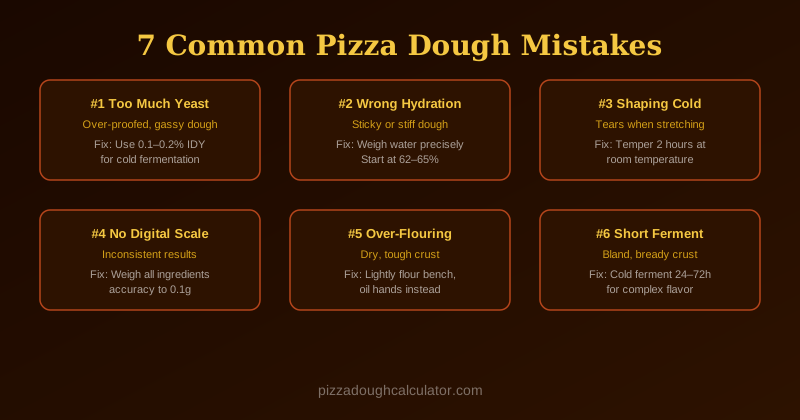
Every pizza baker has had a batch of dough go wrong. You planned dinner around it, and now you're staring at something sticky, dense, or completely flat. Most of these problems have a clear cause and a clear fix. Here are the seven most common mistakes and exactly what to do about them.
Mistake 1: Too Much Yeast in Cold Fermentation
This is the most common error when people first try cold fermentation. They take a recipe designed for a 4-hour room-temperature ferment, put it in the fridge overnight, and wonder why the dough is over-proofed by morning.
What happens: The dough rises aggressively in the fridge, fills the container, and develops a very strong, acidic smell. When you try to stretch it, the gluten structure has broken down and the dough is slack, sticky, and tears easily. It bakes into a flat, dense crust.
The fix: For cold fermentation, use 0.1–0.2% IDY; not 0.5–1% that same-day recipes require. A 560g batch of Neapolitan dough for cold ferment needs just 0.33–0.67g of IDY. Use the dough calculator to get the exact amount based on your batch size and yeast type.
Mistake 2: Skipping the Scale
Measuring flour by volume is the second most common problem. A "cup" of flour scooped directly from the bag can weigh anywhere from 120g to 160g. A recipe that says "2 cups" could actually mean anywhere from 240g to 320g of flour; that's a 33% variation that blows up your hydration percentage completely.
What happens: Your dough is either too dry and stiff (too much flour) or too wet and slack (too little flour), and you compensate by adding water or flour by feel until you lose track of your actual formula.
The fix: Use a digital kitchen scale for every ingredient, including water. Flour: weighed. Water: weighed. Salt: weighed. Yeast: weighed. If your scale doesn't go to 0.1g, you can't accurately measure yeast percentages below 0.5%. For cold fermentation, you need a scale accurate to 0.1g.
Mistake 3: Stretching Cold Dough
Pull cold dough ball straight from the fridge and try to stretch it and it will tear immediately. The gluten is contracted and the dough is stiff from the cold.
What happens: You try to stretch it anyway, it tears, you patch it, it tears again. The finished pizza has an uneven thickness, thick patches over the patches, and a tough, dense crust in places.
The fix: Remove dough balls from the refrigerator 2 hours before baking. Leave them in their individual containers at room temperature. After 2 hours, the dough should feel soft, slightly puffy, and spring back slowly when pressed (not immediately). If it still snaps back quickly, give it another 30–60 minutes.
Mistake 4: Not Developing Gluten Fully
Under-kneaded dough lacks the gluten network to hold fermentation gases, producing a flat, dense crust.
What happens: The dough looks fine when you put it away, but it doesn't rise much, or it rises and then collapses. The baked crust is flat and bread-like rather than airy with good oven spring.
The test: The windowpane test. Stretch a golf ball-sized piece of dough between your fingers. If it stretches thin enough to see light through without tearing, the gluten is developed. If it tears immediately, keep kneading.
The fix: By hand, this takes 8–10 minutes of actual kneading, not occasional folding. By stand mixer with a dough hook: 5–6 minutes at medium speed. After kneading, the dough should be smooth, slightly tacky, and hold its shape.
Mistake 5: Water Temperature Too Hot
Hot water kills yeast instantly. This happens most often when bakers try to speed things up with very warm water, or when the tap runs hot before settling.
What happens: The dough doesn't rise at all. You wait hours and nothing happens. The dough bakes into a dense, cracker-like crust.
The numbers: Yeast dies at temperatures above 115°F (46°C). For IDY, room-temperature water is fine; no proofing needed. For ADY, use water at 100–110°F. Use a kitchen thermometer to check.
The fix: If you're using IDY, use water at room temperature (68–75°F). If using ADY, aim for 100–110°F and test with a thermometer. If you suspect your yeast is dead, dissolve a small amount in warm water with a pinch of sugar and wait 10 minutes. No foam = dead yeast, start over.
Mistake 6: Skimping on Salt
Salt does more than just flavor; it strengthens the gluten network and controls fermentation speed. Under-salted dough ferments too fast and has a weaker structure.
What happens: The dough feels softer and more fragile. It over-proofs faster than expected. The baked crust tastes flat and lacks complexity.
The AVPN specification: 2.5–3% salt by baker's percentage for Neapolitan pizza. For a 333g flour batch, that's 8.3–10g of salt. This may sound like a lot, but most of it ends up in the whole crust.
The fix: Don't eyeball salt. Use a scale. And remember: don't mix salt directly with yeast before adding them to flour; salt at high concentrations inhibits yeast activity. Keep them on opposite sides of the bowl when adding to flour.
Mistake 7: Not Accounting for Kitchen Temperature
Fermentation speed changes significantly with temperature. A kitchen at 75°F in summer will ferment dough much faster than a 65°F kitchen in winter.
What happens: Your dough is ready 2 hours early (over-proofed) in summer, or 2 hours late (under-proofed) in winter. The timing that worked in April doesn't work in August.
The fix: Adjust yeast percentage with the seasons. In summer, reduce yeast by 20–25% compared to winter amounts. Or shift to cold fermentation (which is much more temperature-stable) and use a refrigerator that you know stays at 38–40°F.
The pizza dough ingredient calculator gives you precise yeast amounts; from there, adjust based on your kitchen conditions and experience. And for a deeper look at fermentation science and cold proofing, read our cold fermentation guide.
For more background on hydration and how it interacts with these variables, see our pizza dough hydration guide. Understanding our about page explains the verification process behind these recommendations.