Hydration is the most debated variable in pizza dough; and once you understand it, you'll stop guessing and start making better pizza consistently. This guide covers what hydration actually means, how it affects your dough, and exactly which percentage to use for each pizza style.
What Hydration Percentage Actually Means
Hydration is expressed as a baker's percentage: the ratio of water weight to flour weight. At 65% hydration, you're adding 65g of water for every 100g of flour. That's it. The percentage stays the same no matter how large your batch is; scale up to 1kg of flour and you'll use 650g of water.
This is different from how most home cooks think about ratios. A standard volumetric recipe might say "2 cups flour, ¾ cup water"; that's roughly 62% hydration, but it depends on how you measure the flour. Using a scale with baker's percentages removes the ambiguity. You can use our dough ratio calculator to see exactly how water weight changes as you adjust hydration.
Hydration Ranges by Pizza Style
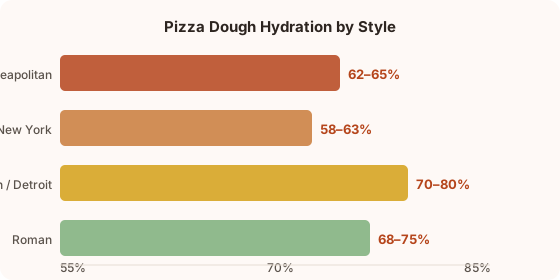
Neapolitan (62–65%): This is the AVPN (Associazione Verace Pizza Napoletana) specification range for authentic Neapolitan pizza. At 63–65%, the dough is smooth, slightly tacky, and extensible. It handles well by hand and stretches into a thin, even round without bouncing back. The relatively moderate hydration helps the dough get that characteristic leopard spotting and char in a 900°F wood-fired oven without spreading too fast.
New York-style (58–63%): A touch drier than Neapolitan, New York dough is easier to throw by hand and produces a wider, thinner crust that holds its shape under a substantial topping load. At 60%, you can stretch it quite thin without tearing. The firmer texture also makes it easier to fold; a structural requirement for a proper New York slice.
Pan pizza / Detroit-style (70–80%): High-hydration pan doughs are more like focaccia batter than traditional pizza dough. You don't hand-stretch them; instead, you press the dough into a heavily oiled pan and let it fill the space during the proof. The extra water creates a soft, open crumb and a crispy, caramelized bottom crust from the olive oil.
Roman al Taglio (68–75%): Roman-style pizza al taglio uses higher hydration than Neapolitan but less than Detroit. It's baked in rectangular trays, cut with scissors, and sold by weight. The dough benefits from a long cold ferment to develop flavor and manage the higher water content.
How Hydration Affects Your Dough
The relationship between hydration and dough behavior isn't linear; small changes make a noticeable difference.
Below 60%: Stiff, firm dough that's easy to shape but can produce a dense crumb. Good for crackers and flatbreads.
60–65%: The sweet spot for most hand-stretched styles. Smooth, manageable dough with good extensibility. Recommended for beginners.
65–70%: Softer, wetter dough that needs more bench flour or an oil coating to handle. Produces a more open crumb and better crust texture in high-temperature ovens. You'll want to develop the gluten fully before shaping; use the stretch-and-fold technique.
70%+: Sticky dough that requires either a stand mixer with a dough hook or patience with wet-hand techniques. The results can be spectacular in the right oven, but the shaping learning curve is steep.
Why Beginners Should Start at 62–63%
Every pizza teacher from Naples to Brooklyn recommends starting in the 62–63% range. At this hydration, the dough responds predictably. You'll feel when the gluten is developed, you can shape it on the bench without it sticking to everything, and it won't collapse into a puddle when you move it to the peel.
Once you can reliably stretch a 280g ball to a 12-inch round without tears; usually after 5–10 batches, bump the hydration up 2% at a time. By the time you reach 68%, you'll have the feel for it.
To calculate exact water amounts for any hydration level, try our pizza dough hydration calculator. Enter your ball count, target weight, and hydration percentage and you get gram-precise results instantly.
The Temperature Factor
Water temperature affects fermentation speed. In summer (kitchen at 75°F), use cold water (55–60°F) to keep fermentation controlled. In winter (kitchen at 65°F), use lukewarm water (75–80°F) to ensure the yeast gets going. The target finished dough temperature is 75–78°F; experienced bakers use a probe thermometer to hit this every time.
This matters more for higher hydration doughs because they ferment faster and are more sensitive to temperature swings.
Adjusting Hydration for Your Flour
Different flour absorbs water differently. Caputo 00 flour at 12.5% protein absorbs slightly less water than American bread flour at 13.5% protein. If you switch flour brands and use the same hydration, the dough consistency will change. King Arthur Bread Flour typically needs about 2–3% more water than Caputo 00 to achieve the same dough feel.
This is one reason professional bakers document their flour brand alongside their formula. Our about page explains how we account for these variables in the calculator's methodology.
Common Hydration Mistakes
Adding too much water at once: Always hold back 5–10% of the water and add it gradually after the flour and most of the water are combined. This gives you fine-tuned control over the final dough consistency.
Measuring by volume: Flour compresses unpredictably in a measuring cup. The same "cup" of flour can range from 120g to 160g depending on how it's scooped. Always weigh both flour and water with a digital scale for accurate hydration.
Changing hydration and everything else at once: If you're troubleshooting a bad batch, change one variable; start with hydration. Adjusting hydration, yeast amount, and flour type simultaneously makes it impossible to identify what fixed the problem.
For more detail on how flour type interacts with hydration, see our pizza flour guide. And if you want to understand the full baker's percentage system that drives these calculations, read baker's percentages explained.