Most pizza recipes give you quantities for a specific batch; enough dough for two 12-inch pizzas, or four. That's convenient until you need to scale. Baker's percentages solve this problem by expressing every ingredient as a ratio relative to flour weight. Once you understand the system, you can scale any dough formula up or down without recalculating every ingredient individually.
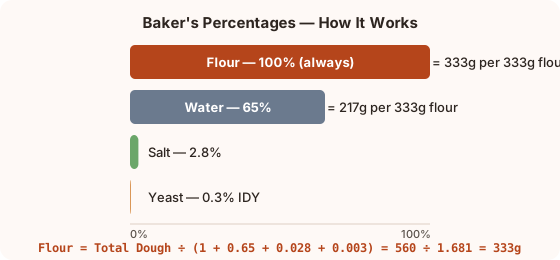
Why Flour Is Always 100%
The baker's percentage system defines flour as 100% regardless of the actual weight. Every other ingredient is then expressed as a percentage of that flour weight.
For a pizza dough with 65% hydration, 2.8% salt, and 0.2% IDY:
- 100g flour → 65g water + 2.8g salt + 0.2g yeast
- 500g flour → 325g water + 14g salt + 1g yeast
- 1000g flour → 650g water + 28g salt + 2g yeast
The percentages stay the same. Only the flour weight changes. This is why professional bakers write formulas in percentages rather than fixed weights; the formula works for any batch size.
The Core Formula
To calculate any batch with baker's percentages, you need to solve for the flour weight first. Our pizza dough calculator does this automatically, but here's the math:
Step 1: Total dough weight = number of balls × ball weight
- Example: 4 balls × 280g = 1,120g total dough
Step 2: Sum all percentages
- 100% (flour) + 65% (water) + 2.8% (salt) + 0.2% (yeast) = 168% total
Step 3: Flour weight = Total dough ÷ (Sum ÷ 100)
- 1,120g ÷ 1.68 = 667g flour
Step 4: Calculate each ingredient
- Water = 667 × 0.65 = 434g
- Salt = 667 × 0.028 = 18.7g
- Yeast = 667 × 0.002 = 1.3g IDY
Verify: 667 + 434 + 18.7 + 1.3 = 1,121g (rounding accounts for the 1g difference)
This is exactly what happens inside the dough ingredient calculator when you click Calculate.
Why It's the International Standard
The baker's percentage system is used by bakeries, pizzerias, and culinary schools worldwide because it standardizes communication. When Tony Gemignani writes in The Pizza Bible that a dough should be at "63% hydration," every professional reading that knows exactly what to do with their own flour weight. The AVPN (Associazione Verace Pizza Napoletana) publishes Neapolitan pizza standards in baker's percentages, not fixed weights, for the same reason.
The Bread Baker's Guild of America and King Arthur Baking Company both teach baker's percentages as foundational knowledge for any serious bread or pizza work. If you've ever looked at a formula in a professional baking textbook and seen a column labeled "%" next to ingredient names, that's baker's percentages.
Reading a Baker's Percentage Formula
A typical pizza dough formula written in baker's percentages looks like this:
| Ingredient | Baker's % |
|---|---|
| Flour | 100% |
| Water | 63% |
| Salt | 2.8% |
| IDY | 0.2% |
| Total | 166% |
To use this formula, you decide your flour weight (say, 1kg), then multiply: water = 1000 × 0.63 = 630g, salt = 1000 × 0.028 = 28g, yeast = 1000 × 0.002 = 2g.
Notice that the "total" percentage (166%) doesn't mean anything by itself; it's just a sum of the ratios, not a meaningful quantity. What matters is the relationship between each ingredient and the flour.
Hydration Is Just the Water Percentage
When pizza makers talk about "hydration," they're using baker's percentages. A 65% hydration dough has 65g of water per 100g of flour. That's all there is to it.
Similarly, when you see "2.8% salt" in a Neapolitan recipe, that means 2.8g of salt per 100g of flour. The AVPN specifies Neapolitan dough at 2.5–3% salt by baker's percentage.
Understanding this makes reading professional pizza recipes much more straightforward. You're not memorizing fixed quantities; you're learning ratios that you can apply to any batch size. For a deeper look at how hydration specifically affects your crust, see our hydration guide.
Yeast Percentages and Fermentation Time
Yeast percentage directly controls fermentation speed. At 0.5% IDY with room-temperature fermentation (70°F), your dough will be ready in about 4–6 hours. At 0.1% IDY with cold fermentation (38°F), you're looking at 48–72 hours; that's exactly what you want for maximum flavor development.
The relationship isn't linear. Cutting yeast by half doesn't double fermentation time; it roughly triples or quadruples it because yeast growth is exponential. This is why experienced pizza makers adjust yeast in small increments (0.05% at a time) when dialing in their timeline.
Our cold fermentation guide covers this in detail. And for yeast type conversions (IDY vs ADY vs fresh yeast), read our yeast guide for pizza dough.
Scaling Up: A Real Example
Suppose you have a recipe for 2 pizzas at 280g each, and you want to make 8 pizzas for a party.
Original batch: 2 × 280g = 560g total
- Flour: 333g (at 63% hydration, 2.8% salt, 0.2% IDY)
- Water: 210g
- Salt: 9.3g
- Yeast: 0.67g IDY
Scale factor: 8 ÷ 2 = 4
New batch: 4 × 280g = 1,120g total
- Flour: 667g
- Water: 420g
- Salt: 18.7g
- Yeast: 1.33g IDY
With baker's percentages, you never need to recalculate the ratios; just scale the flour weight. Or better yet, use the pizza dough scaling tool and let it do the arithmetic for you.
The About Page Has More on Our Formula Methodology
If you want to understand exactly how we implemented these calculations and which industry sources we used to verify accuracy, check out our about page. We cross-reference against multiple authoritative baking sources before publishing any formula.