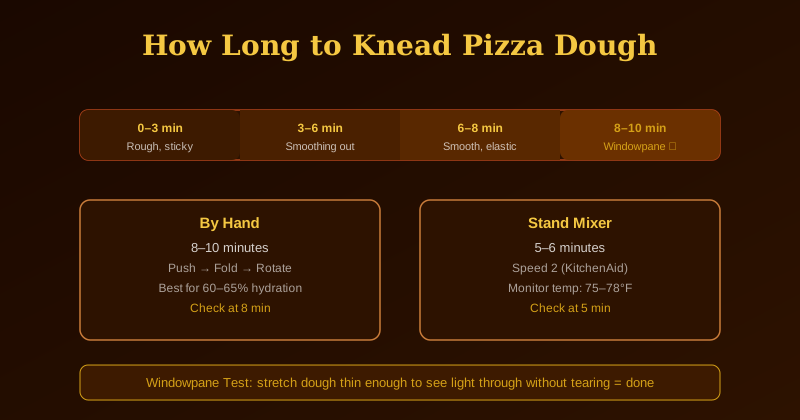
Kneading develops gluten; the protein network that gives pizza dough its structure, elasticity, and ability to trap fermentation gases. Knead too little and you get a flat, dense crust. Knead correctly and the dough becomes smooth, extensible, and ready to ferment. Here's exactly how long to knead, what to look for, and how different methods compare.
Why Kneading Matters
When flour mixes with water, two proteins (glutenin and gliadin) hydrate and form gluten when worked mechanically. The longer and more intensively you work the dough, the more organized and aligned the gluten strands become.
Well-developed gluten does three things for pizza dough:
- Traps fermentation gases: CO2 produced by yeast gets held in the dough matrix, creating bubbles and open crumb
- Provides structure: The crust holds its shape in the oven rather than spreading flat
- Enables extensibility: You can stretch the dough thin without it tearing
Under-developed gluten means the dough tears when stretched, doesn't rise properly, and produces a dense, bready crust rather than a light, airy one.
Hand Kneading: The Method
Hand kneading pizza dough takes 8–10 minutes of consistent work for a standard-hydration dough (60–65%).
The technique:
- Turn the dough out onto a lightly floured surface. Don't over-flour; it changes your hydration percentage and makes the dough stiffer than intended.
- Press the heel of your dominant hand into the center of the dough and push forward.
- Fold the far edge back toward you.
- Rotate the dough 90°.
- Repeat.
The rhythm is push-fold-rotate, push-fold-rotate. Keep it steady, not hurried. You're applying consistent shear force to align the gluten strands, not just mixing.
What you'll notice:
- Minutes 0–3: The dough is rough and slightly sticky. It tears easily if stretched.
- Minutes 3–6: The dough becomes smoother. Stickiness decreases. It's still rough on the surface.
- Minutes 6–10: The surface becomes smooth and slightly glossy. The dough has elasticity; it springs back when poked.
When to stop: Do the windowpane test at 8 minutes. If it passes, stop. If it tears, knead another 2 minutes and test again.
For high-hydration doughs (68%+): Hand kneading is nearly impossible at this hydration; the dough sticks to everything. Use the slap-and-fold method (French kneading) or use stretch-and-fold technique during bulk fermentation instead of traditional kneading. This is how Roman al Taglio and high-hydration Neapolitan doughs are typically made.
Stand Mixer Kneading
A stand mixer with a dough hook cuts kneading time to 5–6 minutes at medium speed. Use speed 2 on a KitchenAid (never higher; over-kneading is possible, and high speed overheats the dough).
Start at low speed for 2 minutes to incorporate all the flour, then increase to medium (speed 2) for 4–5 minutes.
Important: Monitor the dough temperature. A stand mixer generates friction heat. Your dough temperature after mixing should be 75–78°F. If it's higher, the dough will ferment too fast. Use cold water to compensate in warm kitchens.
Do the windowpane test at 5 minutes. Most doughs at standard hydration (60–65%) will be done by 6 minutes. High-protein bread flour doughs may need the full 8 minutes.
The Windowpane Test
This is the definitive test for gluten development, used by professional bakers worldwide.
- Pinch off a golf ball-sized piece of dough.
- Stretch it slowly and gently between your fingers.
- Keep stretching until you have a thin membrane.
- Hold it up to a light source.
Pass: The dough stretches thin enough to see light through (or almost) without tearing. The membrane looks translucent.
Fail: The dough tears before reaching a thin membrane. Continue kneading 2 minutes and test again.
For Neapolitan dough at 65% hydration with Caputo 00 flour, the windowpane usually forms after about 8 minutes of hand kneading. Higher-protein bread flour takes slightly longer to develop.
Kneading vs Stretch-and-Fold
Traditional kneading isn't the only way to develop gluten. High-hydration doughs (68%+) are often developed through stretch-and-fold during bulk fermentation instead.
Stretch-and-fold method:
- After mixing (don't knead), let the dough rest for 30 minutes
- Stretch one edge of the dough up as high as it will go without tearing, then fold it over the top
- Rotate 90° and repeat. That's one set: 4 folds total
- Repeat every 30–45 minutes for 3–4 sets during the first 2 hours of fermentation
- After 3–4 sets, the dough will be smooth and elastic
Stretch-and-fold produces gentler gluten development than kneading. The dough ends up slightly more extensible and less springy; ideal for thin Neapolitan crusts.
Over-Kneading: Is It Possible by Hand?
By hand: difficult. You'd need to knead for 20+ minutes to start breaking down gluten. In practice, hand kneading rarely goes long enough to over-knead.
By machine: possible at high speeds or with very long mixing times. Signs of over-kneading: dough becomes very sticky again (oxidation starts breaking down gluten), dough tears easily, texture is rough and grainy. If this happens, let the dough rest for 30 minutes, and it often recovers.
After Kneading
When kneading is complete:
- Round the dough into a tight ball by pulling the surface taut and pinching underneath
- Lightly oil the bowl or container
- Cover tightly and proceed to bulk fermentation
For cold fermentation (the recommended approach for best flavor), see our cold fermentation guide. For calculating exact ingredient amounts before you knead, use the pizza dough calculator.
One note: if you're experiencing dough that tears during stretching after kneading and fermentation, the problem usually isn't kneading; it's that the dough was shaped too cold. Read common pizza dough mistakes for a full troubleshooting breakdown.